by Shuo Ma (San Diego State University)
Mar 17, 2026
Ocean Acoustic Waves
This article was initially submitted in December 2025
Since Hiroo Kanamori introduced the concept of tsunami earthquakes in 1972, the scientific community has recognized that large tsunamigenic events often exhibit a marked depletion of high-frequency seismic radiation. These earthquakes may be only weakly felt on land yet can generate destructive tsunamis tens of minutes later. This behavior is particularly well documented along the northern Japan Trench.
The 1896 Sanriku tsunami earthquake produced very weak shaking but generated a large tsunami that killed about 22,000 people. A similar pattern was observed during the 2011 Mw 9.1 Tohoku–Oki earthquake: the largest tsunami runup—up to 40 m—occurred along the Sanriku Coast, more than 100 km north of the epicenter. That tsunami source overlapped the 1896 rupture zone but was largely absent from seismic and geodetic models, consistent with weak high-frequency radiation.
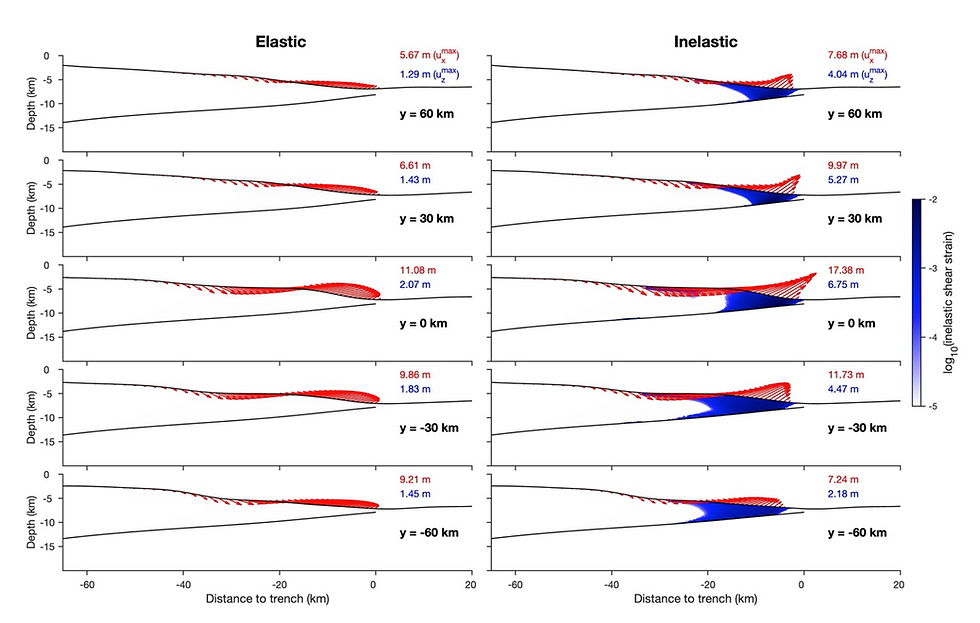
A 2023 study (Ma, 2023) showed that these anomalies can be explained by inelastic deformation of the sedimentary wedge in the northern Japan Trench. In this framework, weak sediments undergo inelastic deformation that generates large seafloor uplift without requiring large shallow slip, while simultaneously dissipating energy and suppressing high-frequency seismic radiation. A recorded seminar on this study is available at: https://earthquake.usgs.gov/contactus/menlo/seminars/1448
In two recent papers (Ma and Du, 2025; Du and Ma, 2025), we extended this concept using fully coupled models of dynamic rupture, ocean acoustic waves, and tsunami for both the 2011 and 1896 events. These simulations show that strong tsunamis can occur even when ocean acoustic waves are weak—again consistent with depleted high-frequency radiation—indicating that acoustic signals alone do not provide a reliable basis for early tsunami warning.
A recent study by Henneking et al. (2025) presents a computational model for real-time tsunami forecasting using ocean-bottom pressure data. Their approach assumes that ocean acoustic waves carry sufficient high-frequency information to resolve complex dynamic seafloor deformation. However, tsunamis are governed primarily by long-period or quasi-static seafloor displacement rather than by the detailed high-frequency dynamics of fault rupture. In other words, the processes that generate tsunamis occur at much longer timescales than the acoustic signals used in these forecasting approaches. In events where high-frequency radiation is naturally depleted—such as tsunami earthquakes—the acoustic signal may be too weak for this method to detect the developing tsunami. Their model may therefore be most effective when strong acoustic waves are generated, for example by rapid slip, although further testing is needed.
When acoustic waves are weak or propagate away from the source, the effective dimensionality of the problem collapses, and the framework effectively reduces to a shallow-water model with far fewer spatiotemporal unknowns—by nearly nine orders of magnitude—eliminating the need for large-scale computation. Under these conditions, rapid-warning capability is greatly diminished, and high-resolution 3-D modeling may not yield meaningful results given the long-period nature of tsunami signals. Without incorporating the essential physics of tsunami generation or recognizing these limitations, claims of a breakthrough in tsunami early warning risk being misleading.
A revised version of this discussion was published as an SRL Opinion article (Ma, 2026).
References
Ma, S. (2023). Wedge plasticity and a minimalist dynamic rupture model for the 2011 Mw 9.1 Tohoku–Oki earthquake and tsunami. Tectonophysics, 869, 230146.
https://doi.org/10.1016/j.tecto.2023.230146
Ma, S., & Du, Y. (2025). Wedge inelasticity and fully coupled models of dynamic rupture, ocean acoustic waves, and tsunami in the Japan Trench: The 2011 Tohoku–Oki earthquake. Tectonophysics, 910, 230831.
https://doi.org/10.1016/j.tecto.2025.230831
Du, Y., & Ma, S. (2025). Wedge inelasticity and fully coupled models of dynamic rupture, ocean acoustic waves, and tsunami in the Japan Trench: The 1896 Sanriku earthquake. Journal of Geophysical Research: Solid Earth, 130, e2025JB032410.
https://doi.org/10.1029/2025JB032410
Ma, S. (2026). Ocean acoustic waves in real-time tsunami forecasting: Opportunities and limitations. Seismological Research Letters, xx, 1–2.
https://doi.org/10.1785/0220250451